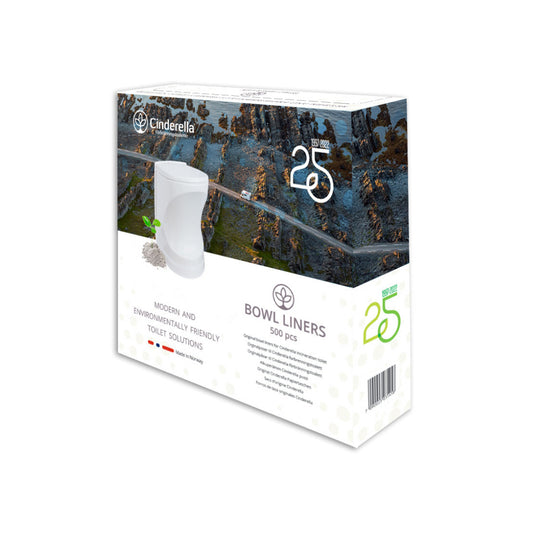

Essential for optimal toilet function. Discover the design, materials, and production of our new bowl liners.
Cinderella incineration toilets offer a unique solution for waste management. A key component of these toilets is the bowl liner, which plays a crucial role in the efficient transportation of waste to the incineration chamber. In this article, we'll delve into the production process, materials used, and what goes into making Cinderella bowl liners.
Production process
The production of Cinderella bowl liners takes place at our state-of-the-art facility in Lyngen, Norway. An automated process involves bonding multiple layers of paper together and cutting the bowl liner to the desired size. Advanced machinery ensures precision and efficiency throughout the production process.

Behind the scenes: The machine that produces Cinderella's bowl liners.
What type of paper is used in the bowl liners?
The choice of paper matters for how well the liner performs during use and incineration. Our bowl liners are made from unbleached, brown kraft paper, which we receive in large rolls from Mondi Group in Sweden. Mondi is a global leader in packaging and paper production, with factories in more than 30 countries.

Large rolls of unbleached kraft paper, sourced from Sweden, are the key ingredient in our bowl liners.
Mondi Group is a member of both FSC, which ensures sustainable forest management, and PEFC, the world's largest certification system for sustainable forestry. We choose to work with suppliers who meet high standards for quality, backed by recognized certifications such as these.
We have transitioned to using unbleached paper for our liners. By switching to unbleached paper, we have eliminated the use of harmful chemicals such as chlorine and bleach in the production process.
Do the bowl liners contain plastic?
To ensure optimal functionality and prevent moisture leakage, our bowl liners incorporate a thin plastic film on the inside.
This film is made from LDPE (low-density polyethylene) and amounts to only 10 grams per square meter of paper. LDPE is a thermoplastic that melts at 110-115°C (230-239°F). During the incineration process, where the temperature reaches 500-600°C (932-1112°F), the plastic film melts completely, leaving no solid residue behind.
We keep the amount of plastic as low as possible while maintaining the liner's functionality, and we work with suppliers such as Mondi Group, who hold FSC and PEFC certification for the paper used in our liners.

See how our bowl liners are built: A sturdy foundation of brown kraft paper, protected by a waterproof LDPE coating.
How does Cinderella work with sustainability and the environment?
We continuously evaluate our material choices to reduce their footprint where we can, for example by keeping the plastic content in our bowl liners as low as possible (just 10 grams per square meter), and by working with suppliers such as Mondi Group, who hold FSC and PEFC certification for the paper we use. Our goal is to keep finding solutions that balance functionality with environmental considerations.

Our high-quality bowl liners are carefully packaged in sturdy boxes, ready for shipment.
Sources:
- Mondi Group is a packaging and paper supplier certified under FSC and PEFC (Read more about their certifications here: Mondi Group sustainability certificates)
- Learn more about FSC: FSC certification
- Learn more about PEFC: PEFC certification